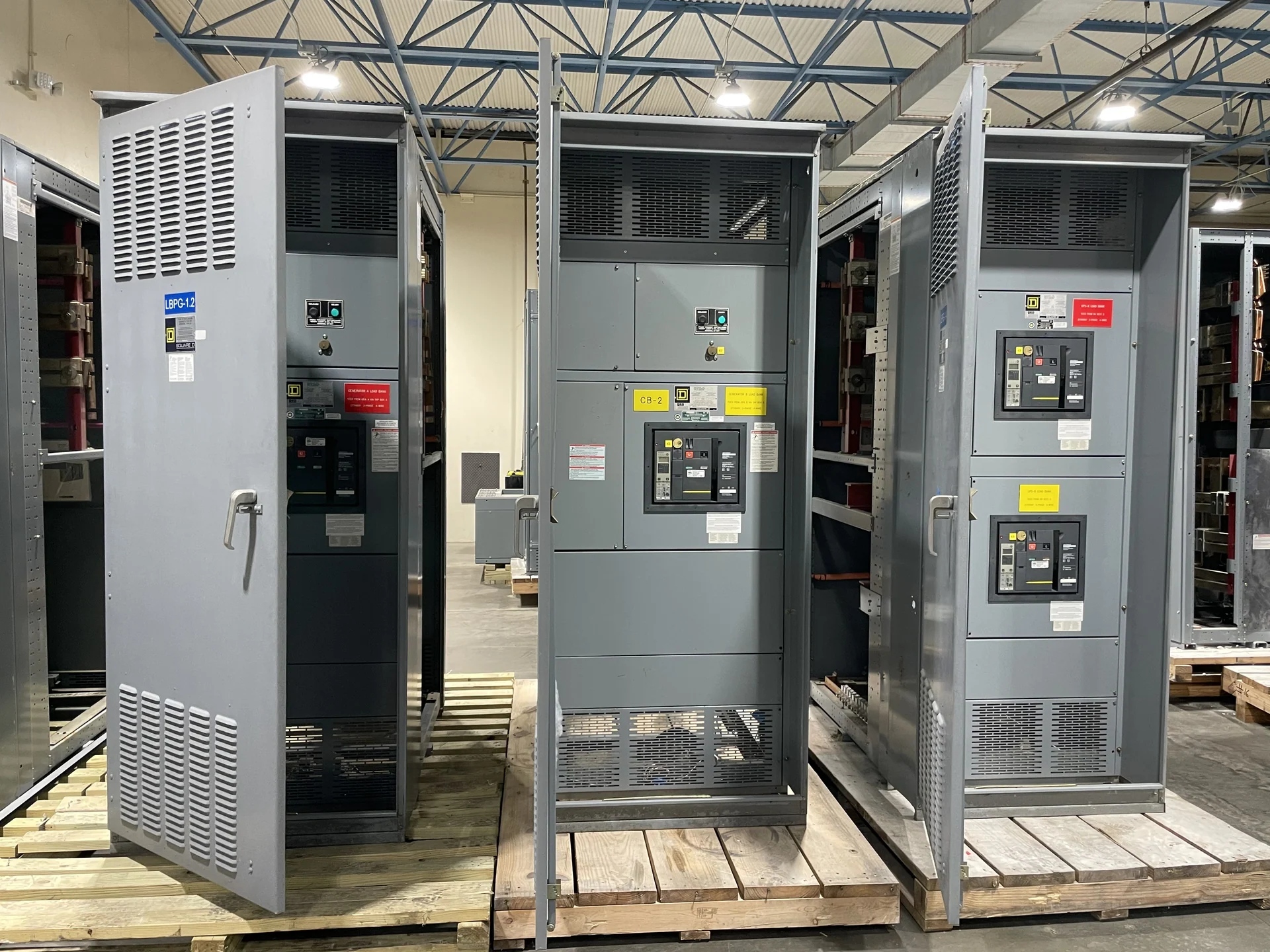
Planning New Hampshire Industrial Distribution
New Hampshire switchgear projects serving industrial pumps, conveyors, and process loads begin with a clear description of the facility and its operating sequence. A manufacturer needs the electrical one-line, system voltage, available fault current, motor list, starting method, control philosophy, environmental conditions, and physical constraints before a useful equipment concept can be developed. A custom lineup may coordinate motor control centers with upstream switchgear, transformers, disconnects, and downstream loads, but the final arrangement depends on engineering review. Switchgear Builders manufactures and supplies new electrical switchgear in the United States, custom to specification, with American components and nationwide shipping for projects in New Hampshire.
Motor Protection for Pumps and Conveyors
Motor protection should reflect each motor's horsepower, full-load current, starting current, duty cycle, acceleration needs, and the consequences of an interrupted process. Pump applications may require attention to dry-run conditions, cycling, or coordinated control signals, while conveyor systems can involve distributed motors, sequencing, and jam-related shutdown logic. Protective devices must be selected and coordinated with the feeder and upstream equipment rather than copied from a generic schedule. A project specification should identify overload protection, short-circuit protection, ground-fault provisions where applicable, and any monitoring points so the manufacturer can integrate the requested arrangement without assuming settings or capabilities.
Starters, Drives, and Heat Management
Across-the-line starters, reduced-voltage starters, and variable frequency drives each affect enclosure space, controls, maintenance access, and the electrical behavior of an industrial load. A starter may suit a motor with a defined starting profile, whereas a drive can support speed control but introduces considerations such as harmonics, bypass requirements, cable length, and heat dissipation. The design team should provide motor data, required acceleration and deceleration behavior, ambient conditions, and any process interlocks. The equipment layout should also reserve practical access for terminations, adjustments, ventilation, and field wiring, subject to the project engineer's requirements and applicable installation rules.
Control Interfaces and Operating Sequences
A motor control center is more useful when its control interface is defined in operational terms instead of only listing devices. Identify whether commands originate from local pushbuttons, a programmable controller, a building system, or another supervisory platform, and document permissives, interlocks, alarms, emergency stops, and restart behavior. For pumps and conveyors, the sequence may include lead-lag rotation, level or pressure inputs, conveyor permissives, or fault annunciation; these are examples for discussion, not assumed project features. Drawings should distinguish power wiring from control and communication circuits, identify terminal points, and show the interfaces expected by the installer and controls contractor.
Enclosure, Site, and Installation Inputs
New Hampshire site conditions should be translated into equipment requirements rather than treated as a generic regional template. Confirm whether the lineup will be indoors or outdoors, the room dimensions and working clearances, cable entry direction, elevation, ambient temperature range, moisture or corrosive exposure, housekeeping concerns, and the route from delivery point to the final location. Provide shipping splits, lifting constraints, foundation or housekeeping-pad information, and field termination responsibilities early in the design. These details influence enclosure selection, layout, access panels, and logistics. The manufacturer can coordinate a custom build and nationwide shipment, while the project team confirms receiving, rigging, installation, and local requirements.
Quote Package and Project Confirmation
A complete request for a New Hampshire motor control center quote should include the one-line diagram, load schedule, motor data sheets, control schematics or sequence narrative, short-circuit information, desired dimensions, environmental conditions, communications requirements, documentation list, and destination details. Also state whether starters, drives, feeder sections, metering, spare provisions, or field-installed accessories are in scope. Ask the manufacturer to identify assumptions, exclusions, required approvals, testing expectations, shipping terms, and the information still needed for final design. Switchgear Builders can review the defined scope for new custom equipment, confirm project-specific service and delivery details, and address any applicable standard or listing requirement without treating UL 891 as automatic for every assembly.