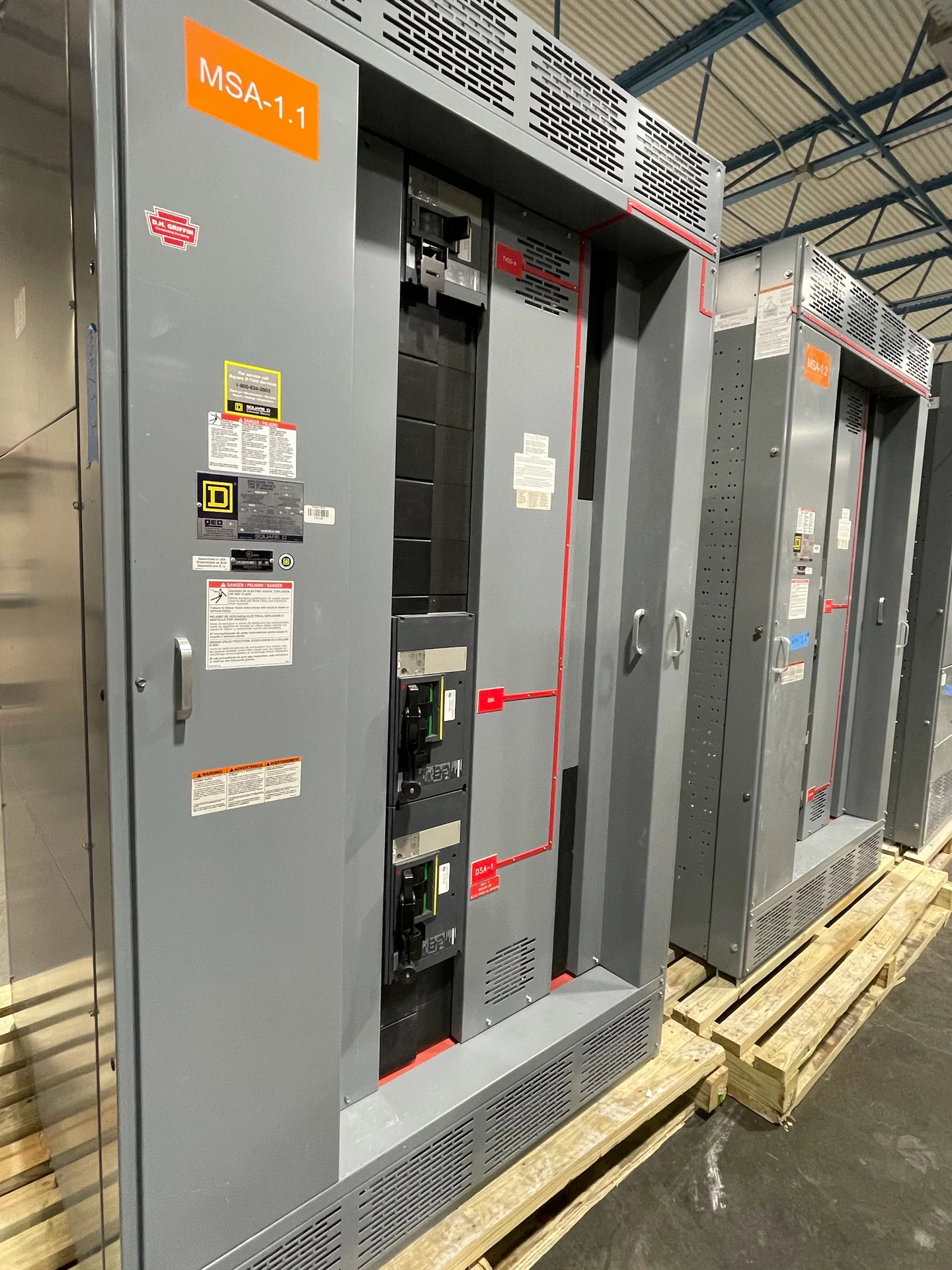
Start with the Cleveland Data Center Power Architecture
Data center distribution switchgear in Cleveland, Ohio should be specified from the electrical architecture outward, rather than selected from a generic equipment description. Begin with the utility service arrangement, transformer interfaces, generator sources, uninterruptible power system boundaries, distribution voltages, phase and wire configuration, grounding method, and the loads that must remain energized during planned maintenance. A useful project package also identifies whether the lineup serves a single path, separate A and B paths, or a more complex source arrangement. Switchgear Builders manufactures new electrical switchgear in the United States, custom to project requirements, with American components and nationwide shipping; final equipment scope still depends on the approved one-line diagram and engineering review.
Define Redundancy Without Assuming Every Path Is Independent
Redundancy is a topology and operating-sequence question, not simply a matter of adding another main breaker. The design team should document which sources feed each critical bus, whether cross-connections are normally open or normally closed, how source interlocking prevents an unintended paralleling condition, and what happens when a source or distribution section is isolated. For a Cleveland data center distribution project, ask whether equipment rooms, generator feeders, transfer equipment, and downstream loads are arranged so a planned task can occur without defeating the intended power path. A manufacturer can build around defined main-tie-main or other configurations, but the owner, engineer, and authority having jurisdiction must establish the required sequence and interfaces.
Plan Maintenance Access Into the Lineup
Maintenance access should influence the physical lineup before dimensions are finalized. Confirm the equipment-room doorway, turning path, finished-floor conditions, working space, front and rear access needs, cable entry direction, lifting provisions, and the location of adjacent equipment. Then distinguish routine operating access from the space needed to inspect, test, isolate, or replace a project-defined device. Drawout arrangements, fixed-mounted devices, barriers, shutters, control compartments, and removable panels can change both serviceability and footprint, so each choice deserves review against the data center’s maintenance procedure. Requesting a layout with shipping splits, weights, connection points, and access assumptions helps the installing contractor coordinate receiving and placement in Cleveland.
Coordinate Generator Interfaces and Transfer Sequences
Generator interfaces require more than naming an emergency source on a one-line diagram. The specification should identify generator feeder conductors, source grounding, breaker or switch functions, control power, status points, permissive signals, metering, synchronization requirements where applicable, and the intended transition sequence. Review how a generator start command, source availability signal, transfer action, retransfer, cooldown, and lockout condition affect the switchgear lineup and downstream loads. If multiple generators or distributed sources are involved, the engineer must define whether they operate independently, in parallel, or through separate transfer paths. New custom switchgear can incorporate the physical and control interfaces that the approved design actually requires, subject to project documentation and verification.
Specify Fault Duty and Protective Coordination Inputs
Protective coordination begins with reliable electrical inputs: calculated available fault current at each relevant bus, nominal and maximum system voltage, continuous load current, conductor information, transformer impedance, grounding details, and the time-current characteristics of upstream and downstream devices. For data center distribution switchgear, compare the desired selectivity and clearing behavior with arc-flash study assumptions, generator contribution, transformer energization, and maintenance settings where those functions are part of the design. Breaker interrupting ratings, bus withstand or short-circuit current requirements, and protection settings should be selected by qualified electrical professionals; do not infer them from facility size or a city name. The final package should capture assumptions and revision status.
Prepare a Complete Manufacturer Inquiry
A focused inquiry for data center distribution switchgear in Cleveland should include the current one-line diagram, load schedule, equipment schedule, site and room information, source data, generator and transfer interfaces, control schematics, metering requirements, enclosure environment, cable-entry preferences, dimensions, shipping constraints, and the requested drawing and test documentation. State which requirements are mandatory and which remain open for engineering coordination. Ask the manufacturer to identify exclusions, assumptions, approval points, and project-specific applicability of standards such as UL 891 rather than treating any standard as automatic. Switchgear Builders manufactures new custom switchgear in the United States and can coordinate nationwide shipment once the project scope and destination requirements are defined.