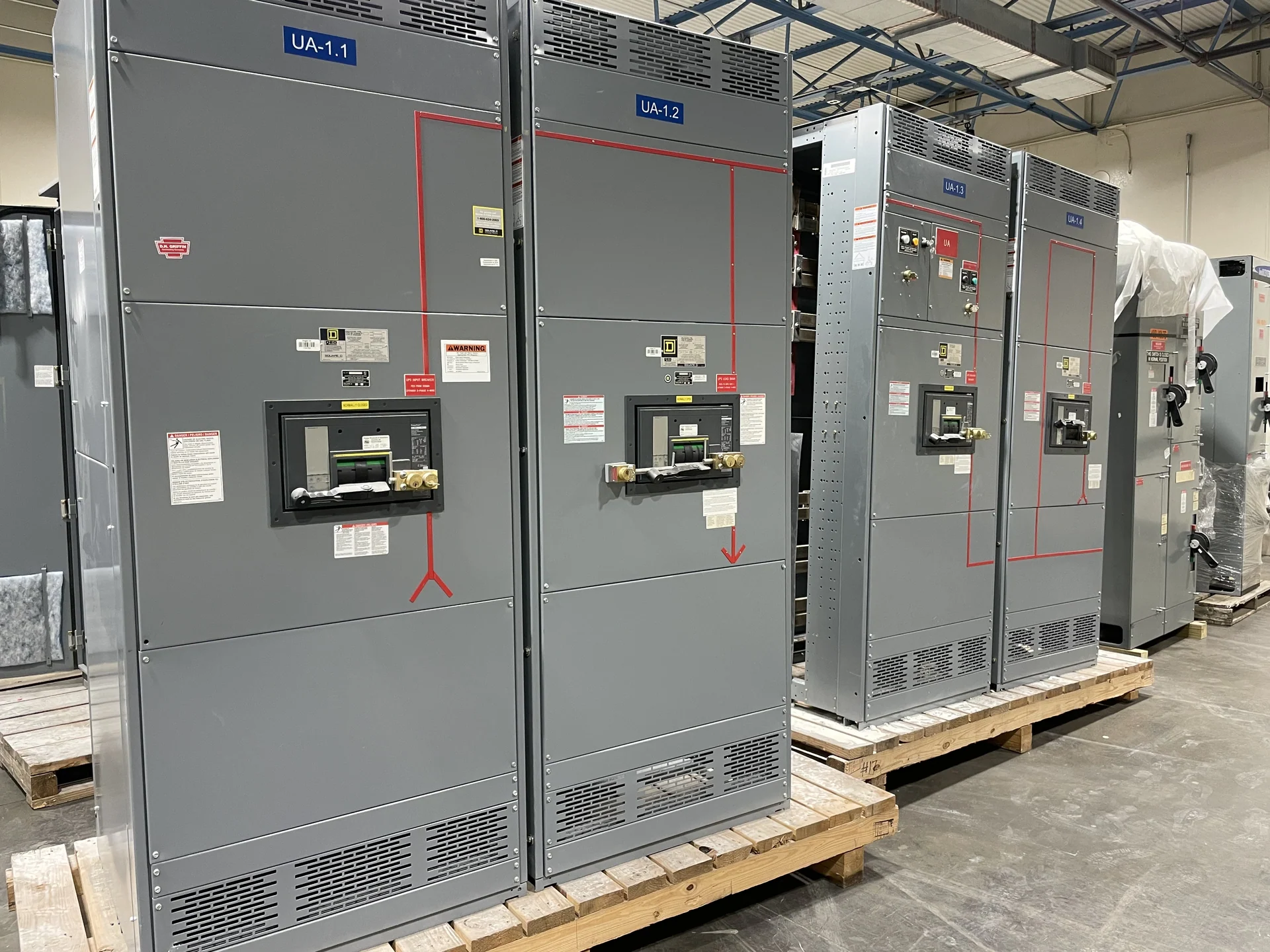
Plan the Pittsburgh Motor Control Center Around the Process
An industrial motor control center for a Pittsburgh project should begin with the process rather than a standard lineup name. Identify whether the equipment serves pumps, conveyors, fans, compressors, mixers, or another combination of loads, then map each motor to its operating duty and control responsibility. A useful design package describes normal and standby operation, simultaneous starting expectations, sequence dependencies, remote commands, local controls, and the consequences of losing one feeder. Those details help a manufacturer build new equipment to a defined application instead of leaving important decisions to field installation. Switchgear Builders manufactures custom electrical distribution equipment in the United States, using American components and offering nationwide shipping; the final equipment scope remains subject to project engineering review.
Define Motor Protection and Feeder Ratings
Motor protection must match the motor data, starting method, feeder arrangement, and available fault current identified by the project's electrical engineer. Provide motor horsepower, voltage, phase, frequency, full-load current, service factor where applicable, starting characteristics, and the required overload or short-circuit protection approach. For a pump station, for example, a motor that starts across the line may impose a different system demand than one operated through a drive. Confirm continuous current, interrupting or withstand requirements, grounding, enclosure conditions, and conductor interfaces for every section. A manufacturer can then coordinate protective devices and bus layout with the documented design, while the responsible engineer confirms settings and compliance with applicable requirements.
Choose Starters, Drives, and Operating Controls
The control method should be selected from the required process behavior, not simply from a preferred component list. Across-the-line starters may suit motors that can tolerate full-voltage starting, while reduced-voltage methods or variable frequency drives may help manage acceleration, flow, speed, or mechanical stress when the application calls for them. Drives also introduce heat, harmonic, bypass, communication, and maintenance questions that affect the motor control center layout. Document whether each bucket needs a disconnect, overload protection, local start-stop controls, a bypass path, network communication, or a hardwired permissive. Clearly separating power, control, and communication requirements gives the builder a practical basis for custom assembly and submittal drawings.
Coordinate Pumps, Conveyors, and Process Interlocks
Industrial motor control centers become useful only when their controls reflect the process interlocks around them. Pump systems may require low-level protection, lead-lag rotation, pressure permissives, or proof that a discharge valve is in the proper position. Conveyors can require pull-cord inputs, guarding signals, jam detection, upstream and downstream permissives, and a defined restart policy after a trip. Process equipment may depend on temperature, flow, vibration, or batch logic supplied by a PLC or other control system. Put the operating sequence in writing, identify which signals are hardwired or networked, and assign terminal points and naming conventions before fabrication. That discipline reduces ambiguity between the equipment builder, controls integrator, and Pittsburgh-area installation team.
Fit the Lineup to the Facility and Installation Plan
Physical coordination deserves the same attention as the electrical schedule. Confirm available room dimensions, lineup orientation, cable entry, feeder routing, ventilation, working clearances, service access, lifting or handling constraints, and the path from receiving to the final electrical room. Industrial facilities may also impose dust, moisture, washdown, corrosive exposure, temperature, or indoor-outdoor transition requirements that influence enclosure selection and component placement. Provide the design team with the one-line diagram, floor plan, equipment schedule, and connection details, then resolve conflicts before release. Switchgear Builders can supply new custom-built equipment for projects shipping across the United States, but destination conditions, freight responsibilities, and field handling should be defined for the specific Pittsburgh project.
Prepare a Complete Manufacturer Inquiry
A focused request for an industrial motor control center should include the project location, one-line diagram, motor schedule, short-circuit study inputs, control narrative, communications requirements, physical dimensions, environmental conditions, and desired documentation. State whether the lineup is a new installation, an expansion interface, or a replacement design, and identify the existing equipment or upstream and downstream connections that must be coordinated. Ask for a proposed bill of material, layout, wiring approach, ratings, exclusions, shipping configuration, and review milestones rather than comparing vague descriptions. When a project specification references a particular standard or UL 891, applicability and any listing or capability must be confirmed for that specific assembly; no blanket assumption should replace project review.