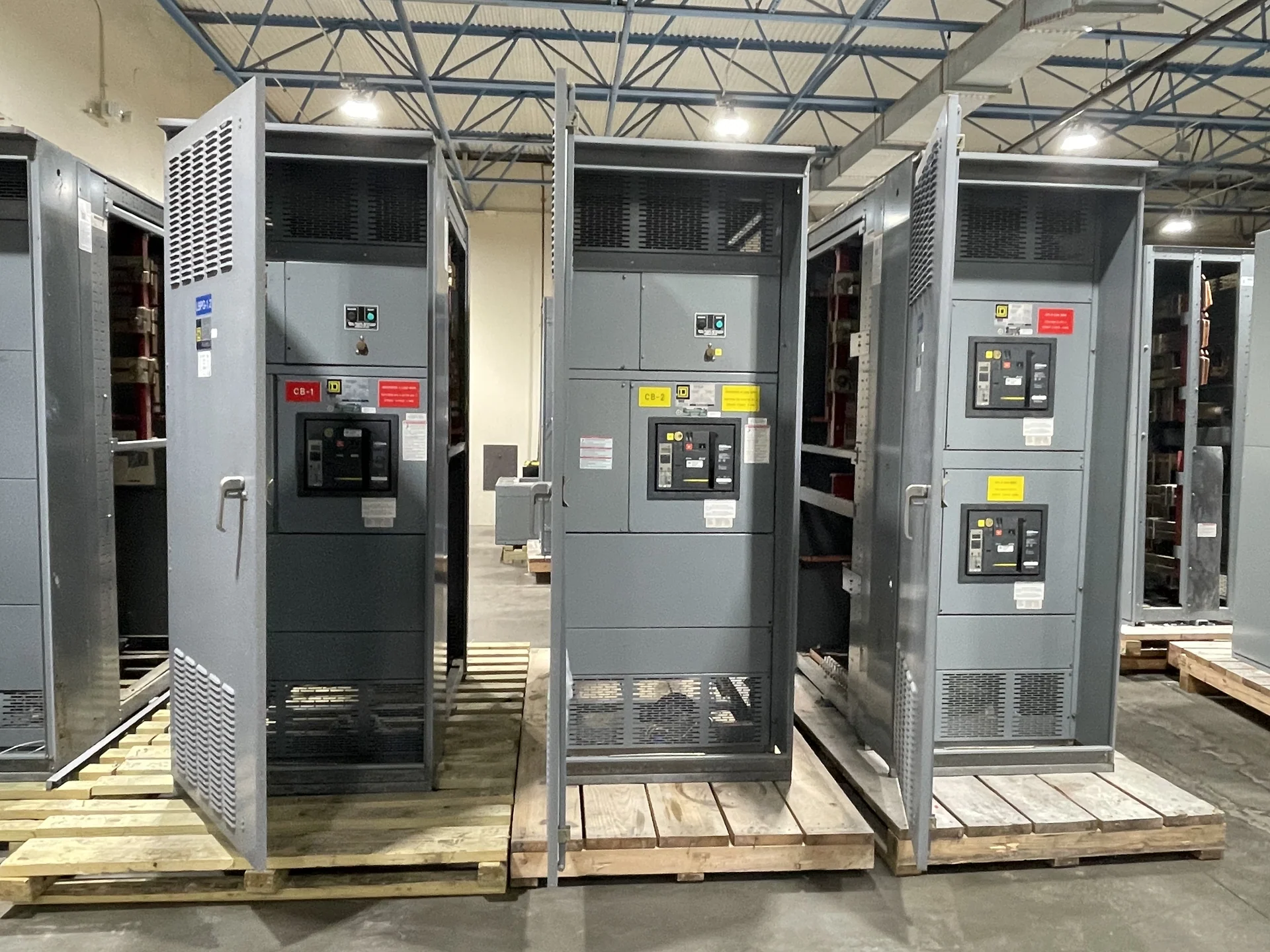
What Pad-Mounted Switchgear Does
Pad-mounted switchgear is outdoor electrical distribution equipment installed on a prepared foundation, commonly near the circuits, transformers, or facilities it serves. Its enclosure brings switching and, where specified, protective functions into a compact, ground-level assembly rather than an indoor lineup. The exact arrangement depends on the distribution one-line diagram: a unit may provide sectionalizing points, feeder switching, fuses, circuit-interruption equipment, or connections between incoming and outgoing conductors. The important question is not simply whether equipment is labeled pad-mounted, but how its sources, load feeders, grounding, operating sequence, and fault duties fit the complete system.
Outdoor Enclosure and Site Planning
Because pad-mounted equipment remains outdoors, the enclosure and its installation interface deserve early attention. Project planning should address rain, sunlight, temperature, moisture, corrosion exposure, drainage, vegetation, access control, clear working space, and the foundation or pad dimensions. Cable entrances, conduit paths, terminations, doors, locks, and operating handles must align with the civil and electrical drawings. Site access also matters: confirm how the assembly will be transported, positioned, inspected, and later reached for qualified maintenance without obstructing roads, equipment, or required clearances. Enclosure and environmental requirements should be selected from actual site conditions and project specifications, not from the product name alone.
Distribution Circuit Interfaces
A useful pad-mounted switchgear specification begins with a clear description of every circuit interface. Identify the incoming source, outgoing feeders, transformer connections, phase and wire arrangement, system grounding, nominal voltage, continuous current, available fault current, and required switching sequence. Cable size and termination details should be coordinated with the electrical engineer and installer, including entry direction, bending space, separable connections where applicable, and phase identification. If the assembly connects utility service, generation, a loop circuit, or multiple transformers, document who operates each device and which interlocks or access controls are required. These details prevent a physically convenient enclosure from becoming an electrically incompatible installation.
Switching, Protection, and Operation
Switching equipment is selected around the operating purpose of the circuit, not merely its location outside. A sectionalizing arrangement may be intended to isolate a feeder segment, while a fused or breaker-based arrangement may address a defined protection strategy; those functions must be coordinated with upstream and downstream devices. Review load current, fault duty, transformer inrush where relevant, grounding method, relay or control needs, visible isolation expectations, and the normal and abnormal operating sequence. The project team should also define labels, mimic diagrams, padlocking or locking provisions, key interlocks, and any remote indication requirements. Protective settings and coordination remain engineering decisions that require the system study and approved project data.
Information Needed for a Custom Build
When requesting new custom pad-mounted switchgear, provide more than a preferred enclosure size. A manufacturer needs the latest one-line diagram, voltage and frequency, phase and grounding information, continuous-current and short-circuit requirements, circuit count, device functions, cable and termination details, enclosure environment, foundation constraints, access expectations, control voltage, metering or indication needs, drawings, and documentation requirements. Include the installation location for shipping coordination, the destination contact, receiving limitations, and any lifting or placement information already established by the site team. A coordinated submittal process can then resolve dimensions, interfaces, nomenclature, and operating details before fabrication.
Buying New Pad-Mounted Switchgear from a Manufacturer
Switchgear Builders manufactures, builds, and supplies new electrical switchgear in the United States, custom to project specifications, with American components and nationwide shipping. For a pad-mounted inquiry, the practical next step is to send the electrical scope and site-interface information rather than relying on a generic catalog description. The resulting review should establish the proposed configuration, device functions, enclosure and environmental requirements, drawings, testing or inspection expectations, packaging, freight responsibilities, and project-specific availability. Any applicable standard, including possible UL 891 relevance, must be identified and confirmed for that particular assembly; applicability is not automatic for every pad-mounted switchgear project.