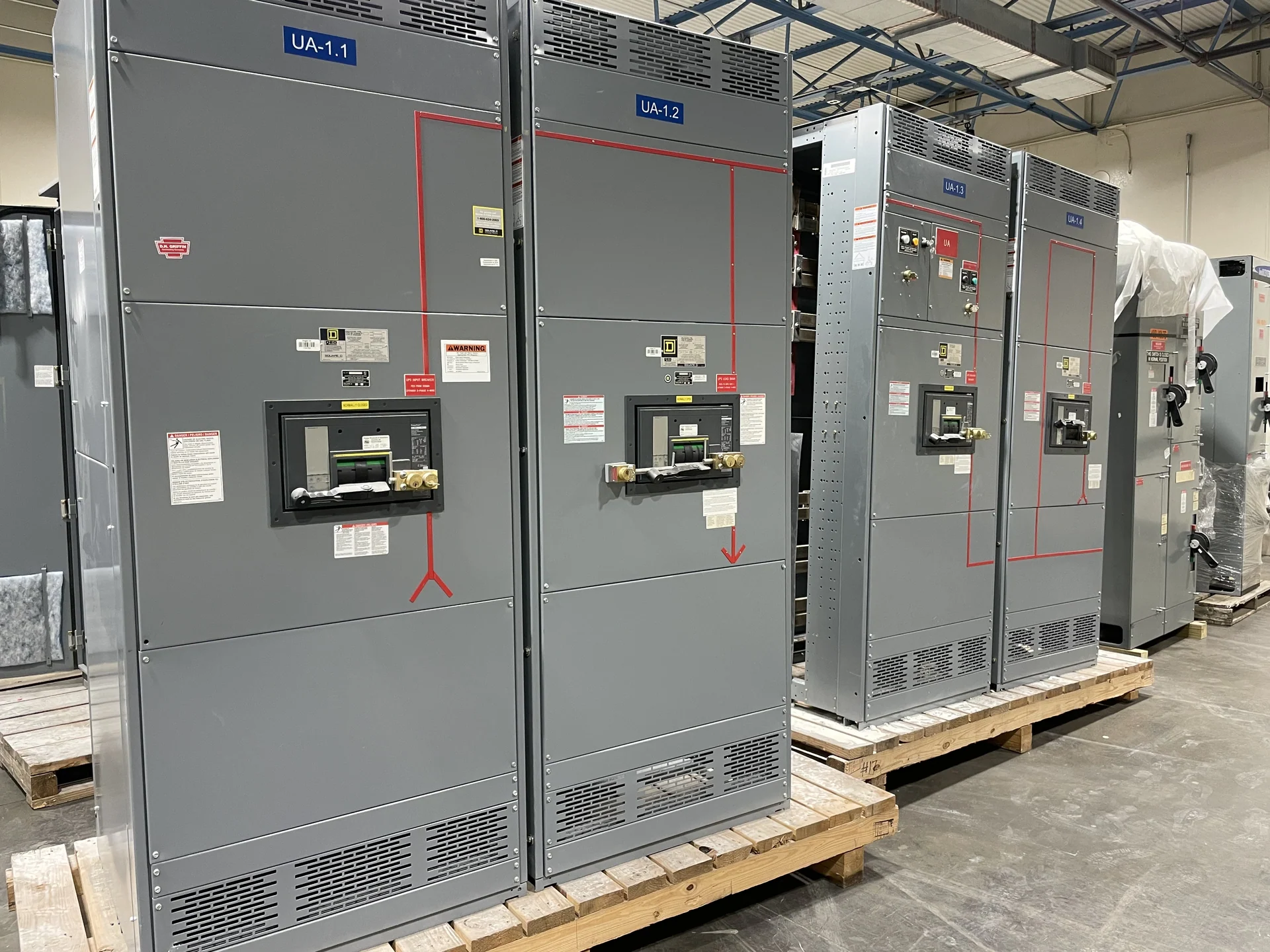
Motor Control Center Definition
A motor control center, commonly called an MCC, is a coordinated electrical assembly that groups motor-control equipment and related devices in one lineup. Depending on the project, the assembly may contain motor starters, circuit protection, disconnecting means, control power equipment, variable frequency drives, metering, and communication components. Its purpose is to organize power and control connections for multiple motors while giving engineers and qualified personnel a structured point for operation, isolation, inspection, and maintenance. An MCC is not simply a collection of unrelated panels; its sections, bus arrangement, wiring, and control interfaces are designed as an integrated distribution assembly.
What Equipment an MCC Can Contain
The contents of a motor control center depend on the loads and operating sequence defined for a particular facility. A section might serve an across-the-line starter, a reduced-voltage starter, a variable frequency drive, a feeder, or a control transformer, while other sections provide incoming power, bus coupling, metering, or spare space identified in the design. Each compartment requires compatible ratings, conductor terminations, heat-management considerations, and access provisions. The equipment schedule should identify motor horsepower or load data, voltage, phase, starting method, protection, control voltage, local controls, remote commands, indication, and any required network connection rather than relying on the general label MCC alone.
How the Assembly Supports Motor Systems
An MCC supports a motor system by bringing branch power, protection, switching, and control wiring into a coordinated physical arrangement. The upstream source and bus must be evaluated alongside feeder conductors, motor circuits, fault duty, grounding, and the starting or speed-control method. Control logic may include permissives, interlocks, overload response, emergency-stop interfaces, alarms, and status signals, but the correct sequence belongs to the project design. Separating power conductors from control wiring, identifying terminals consistently, and documenting each connection can simplify commissioning and later troubleshooting. The finished arrangement still requires installation, adjustment, and operation by appropriately qualified personnel under the governing project procedures.
MCC Layout and Specification Inputs
A useful MCC specification starts with more than a motor list. Provide the single-line diagram, available fault information, system voltage and frequency, phase and grounding arrangement, enclosure environment, incoming and outgoing cable directions, lineup dimensions or room constraints, equipment access path, and the intended installation location. Add motor schedules, starter or drive preferences, control schematics, communications requirements, spare or future provisions, nameplate conventions, testing expectations, and documentation needs. Engineers and installers should also coordinate working clearances, ventilation, conduit entry, anchorage, lifting, and the division of shipping sections. These inputs let a manufacturer develop a custom proposal without guessing at interfaces that affect fabrication or field installation.
MCC Versus Other Distribution Assemblies
An MCC is specialized for organizing motor feeders and their control functions, whereas a switchboard or switchgear lineup may be centered on service, feeder, transformer, or general distribution duties. A panelboard typically serves branch circuits in a more compact format, while a standalone drive cabinet may focus on speed control for selected motors. Boundaries can overlap in a large system, so the correct choice depends on circuit ratings, operating sequence, maintenance approach, available space, and the project engineer's distribution architecture. Terminology should not replace a reviewed one-line diagram: the specified assembly must match the loads, protection scheme, controls, physical interfaces, and applicable project requirements.
Buying a New Custom Motor Control Center
When a project calls for a new motor control center, Switchgear Builders manufactures, builds, and supplies equipment in the United States, custom to the stated electrical and physical requirements, using American components and nationwide shipping coordination. A quote request should identify the motor schedule, drawings, ratings, enclosure conditions, control narrative, documentation, inspection expectations, destination, and installer interfaces. Component selection, construction details, testing, and any standard or listing requirement must be reviewed for the specific project; UL 891 applicability, if raised by the specification, is not automatic and must be confirmed for the proposed assembly.