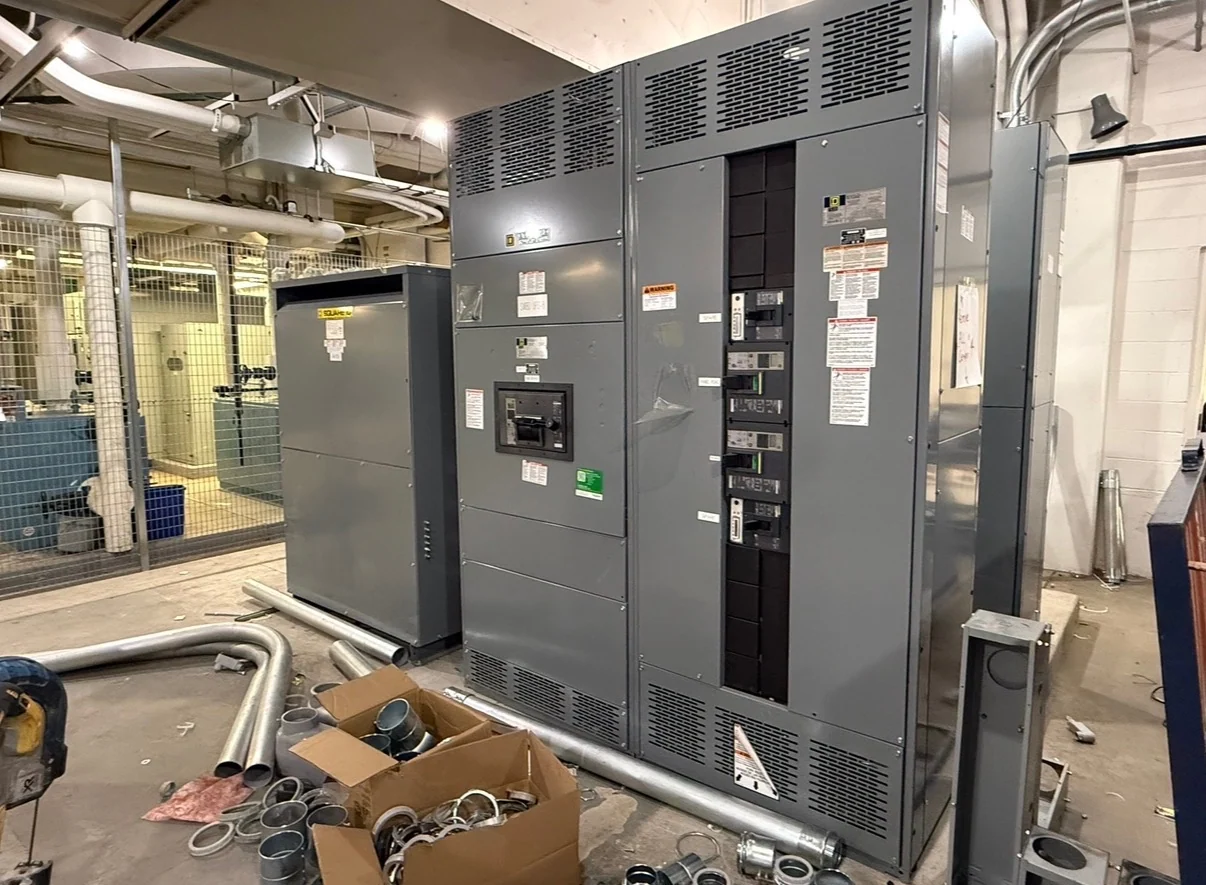
Plan the Campus Distribution Architecture
University power systems often connect a central service, multiple buildings, residence halls, laboratories, athletic facilities, and utility plants across a campus. New switchgear should be planned as part of that distribution architecture rather than as an isolated enclosure. Start with the one-line diagram, source arrangement, feeder destinations, transformer interfaces, normal and alternate paths, grounding method, and operating responsibilities. Also identify which buildings share a feeder, where selective coordination matters, and how maintenance staff will isolate sections without confusing labels or undocumented switching assumptions. Switchgear Builders manufactures new electrical switchgear in the United States, custom to project specifications, with American components and nationwide shipping for campus procurement teams.
Define Ratings for Real Campus Loads
A useful university equipment specification identifies nominal system voltage, frequency, phase and wire configuration, continuous current for mains and feeders, available fault current, interrupting requirements for protective devices, and the specified short-circuit duty of the assembly. Load diversity can vary widely between classrooms, research instruments, cooling equipment, kitchens, residence buildings, and event spaces, so calculated demand and future capacity deserve separate review. Confirm transformer data, conductor sizes, utility information, and protective coordination inputs before selecting a lineup or requesting a firm manufacturer quote.
Coordinate Sources, Ties, and Controls
Campus distribution may involve utility sources, standby generators, automatic transfer equipment, bus ties, or feeders reserved for selected essential loads. The equipment design must state which devices may close, which sources are mutually exclusive, what happens during a source loss, and how operators receive status and alarms. A control narrative, point list, interlock matrix, and terminal schedule can prevent ambiguity between the switchgear builder, electrical engineer, controls contractor, and installer. Any automatic sequence should be reviewed against the campus operating procedure and the project protection study before fabrication.
Support Phased Electrical Upgrades
University renovations rarely occur on an empty site. A phased upgrade may need new feeders for a building addition, a replacement lineup in a constrained electrical room, or a planned connection between new and retained distribution sections. Provide room dimensions, access routes, working clearances, cable-entry directions, termination space, anchorage information, outage restrictions, and the intended sequence for installation. Clear boundaries around demolition, temporary power, shutdowns, and final energization help the manufacturer develop a buildable custom package without assuming that field conditions match old drawings.
Prepare Documentation and Verification
For a campus project, documentation should be treated as an operating resource, not merely a submittal hurdle. The request can identify required one-line diagrams, elevations, wiring diagrams, device schedules, nameplate data, spare-space definitions, terminal labels, settings information, shipping splits, and inspection or test records. Establish acceptance criteria and witness requirements before production begins. If UL 891 is relevant to a particular switchboard or assembly, its applicability, construction requirements, and any project-specific listing or verification must be confirmed for that project rather than assumed from the equipment category.
Build a Complete Manufacturer Inquiry
A university procurement request becomes more actionable when it includes the latest one-line diagram, load and fault studies, specifications, schedules, room and delivery constraints, control descriptions, metering needs, environmental conditions, and a list of required deliverables. Identify whether the work is a new central lineup, a building feeder, an expansion, or a phased replacement, and note who will approve drawings and coordinate field installation. A direct inquiry to the American manufacturer can then address custom construction, American component selection, documentation, and nationwide shipment in the context of the defined campus project.