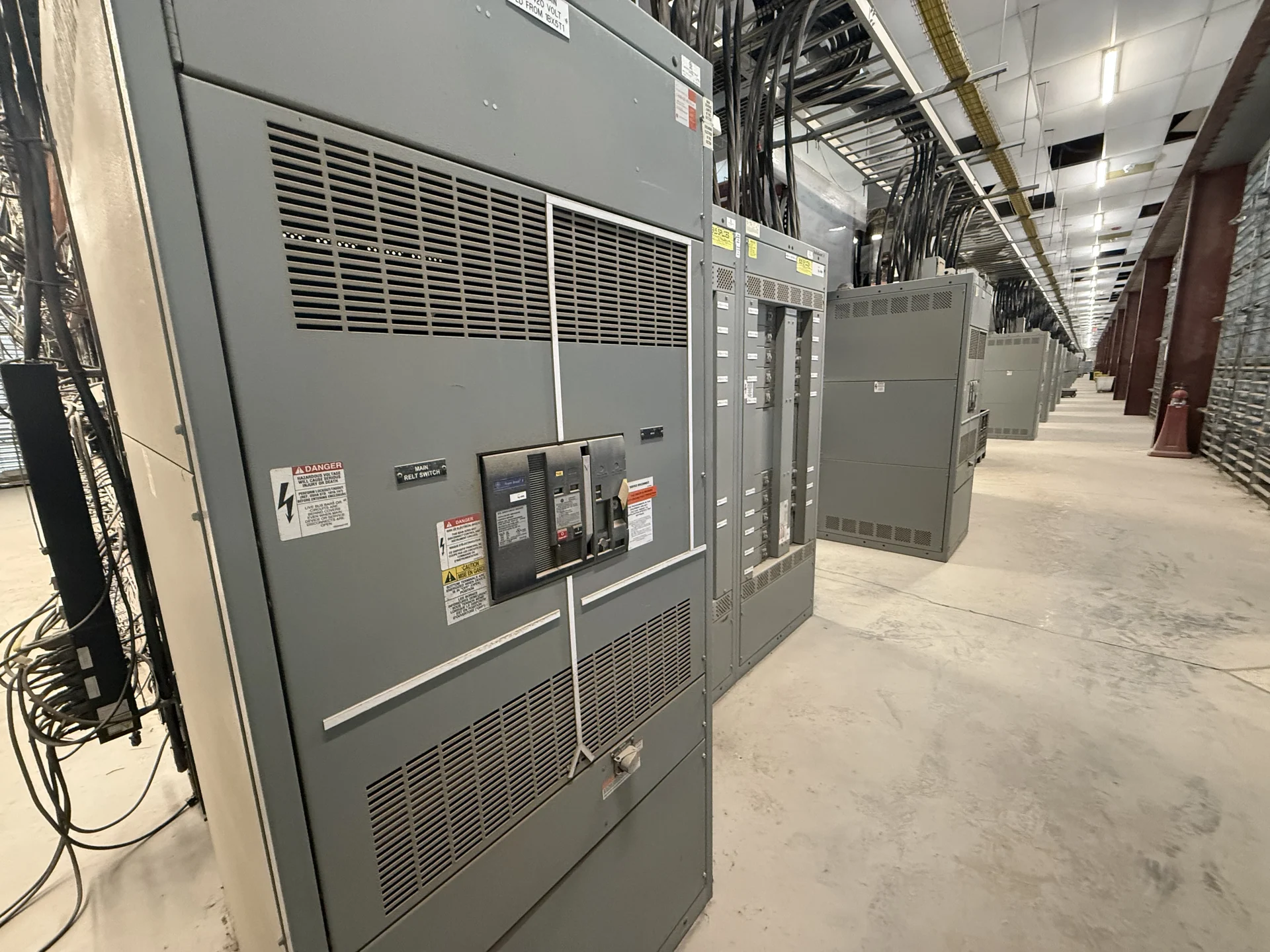
Start with the Nashville service interface
For a commercial or industrial project in Nashville, Tennessee, a service-entrance switchboard begins with the electrical service arrangement rather than a preferred enclosure shape. The design team should identify the serving utility, service voltage, phase and wire configuration, grounding method, service conductors, and point where utility responsibility ends. Those inputs establish the main disconnecting means, metering space, service compartments, and feeder connection strategy. Switchgear Builders manufactures new custom electrical distribution equipment in the United States, using American components and shipping nationwide. A project inquiry should include the latest one-line diagram and utility requirements so the proposed assembly can be evaluated against the actual site and service conditions.
Define metering and disconnecting means
Utility metering can affect the switchboard lineup, compartment dimensions, conductor routing, and access requirements. Before requesting project-specific equipment information, confirm whether the Nashville service calls for instrument transformers, a dedicated meter section, customer metering, utility-owned devices, or another arrangement identified by the serving utility. Also document the number and location of service disconnects, the desired main device arrangement, emergency or legally required loads, and any source-transfer interface. These details prevent a nominal service rating from masking a layout problem. The final configuration should follow the approved electrical design and the utility's applicable review requirements, not a generic local assumption.
Coordinate feeder circuits and future capacity
A useful switchboard schedule lists each feeder circuit, connected load, calculated demand, conductor size, protective device type, and destination. For a Nashville office, warehouse, manufacturing area, or mixed-use facility, feeders may serve different operating schedules and fault contributions, so the lineup needs clear circuit identification and a maintainable physical arrangement. Ask the engineer to distinguish present loads from planned expansion, spare provisions, and spaces that must remain available for later equipment. Future capacity is not simply empty space; bus, main device, enclosure, heat, and cable-entry choices all require review. Switchgear Builders can build new equipment custom to the project's documented circuit and dimensional requirements.
Verify available fault current and ratings
Available fault current at the service is a central input for selecting the main and feeder protective devices and for evaluating the assembly's specified short-circuit capability. Request the utility fault-current information or the engineer's calculation, then reconcile it with transformer data, conductor length, parallel sources, generator connections, and downstream coordination assumptions. The equipment specification should identify continuous current, voltage class, frequency, interrupting ratings for devices, bus requirements, enclosure conditions, and grounding details as applicable. Do not infer a rating from the Nashville location alone. A qualified design review must confirm that each selected device and the complete lineup suit the actual service and installation.
Plan enclosure, room, and installation interfaces
Physical coordination is especially important when a service-entrance switchboard must enter an existing electrical room or connect to utility service conductors at a constrained site. Provide room dimensions, wall and door locations, equipment access path, working-space drawings, cable-entry direction, termination height, housekeeping pad information, environmental exposure, and any seismic or structural criteria specified for the project. Identify whether the lineup is indoors or outdoors and what enclosure requirements follow from that location. Confirm shipping sections, lifting points, approximate weights, and receiving responsibilities during project coordination. These inputs let the manufacturer develop a practical new assembly without assuming that every Nashville site has the same access or construction conditions.
Prepare a complete manufacturer inquiry
A strong request for service-entrance switchboards in Nashville combines technical, physical, documentation, and commercial information in one package. Include the one-line diagram, panel and feeder schedules, service and fault-current data, utility metering criteria, site address for shipping, indoor or outdoor conditions, dimensions, cable details, control or monitoring requirements, applicable drawings, requested inspection or testing scope, and the desired delivery coordination point. Identify exclusions and responsibilities clearly, including engineering approval, field installation, rigging, utility review, and final connections. Switchgear Builders supplies new custom switchgear and switchboards directly from the manufacturer, with nationwide shipping; project-specific scope, applicability of standards, and delivery details must be confirmed for the inquiry.