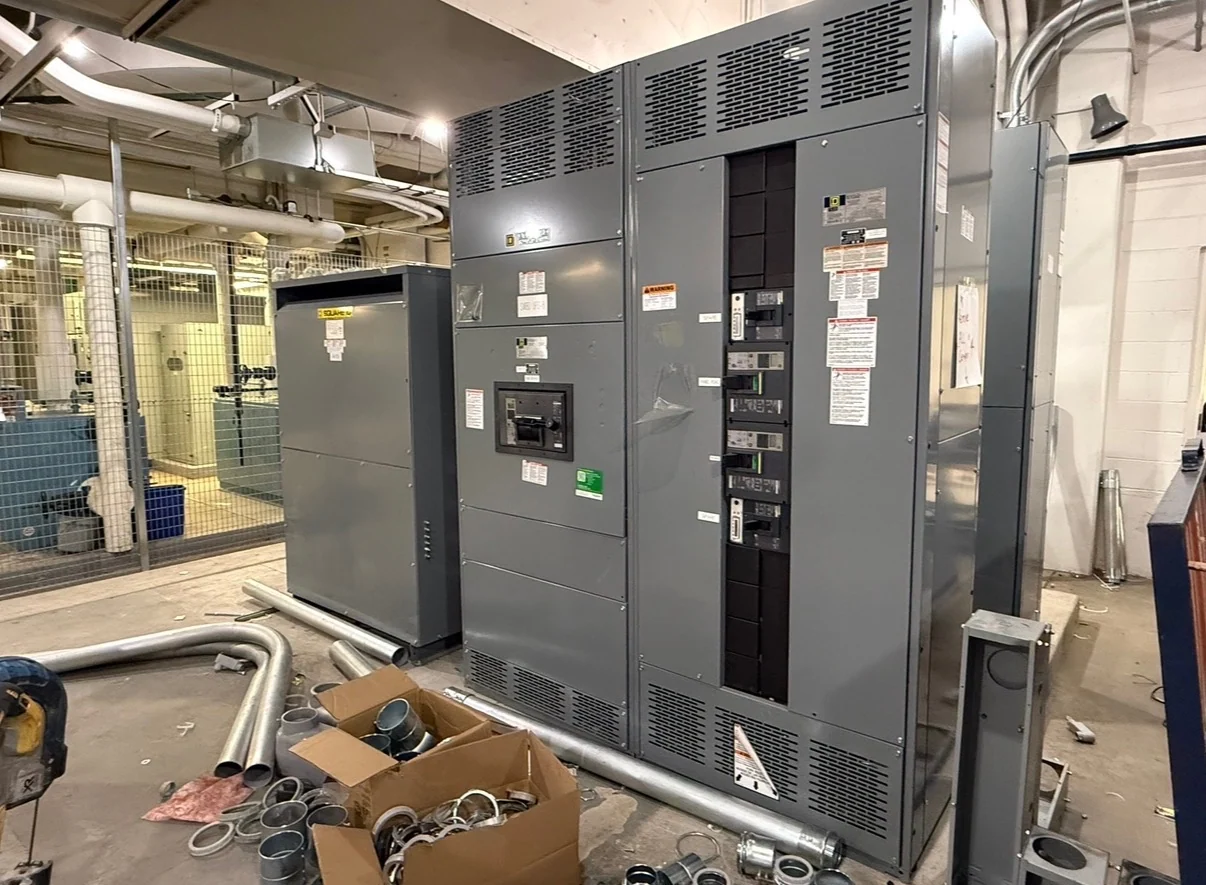
Houston Water and Process Power Planning
Water treatment plants and process facilities in the Houston, Texas market can place varied demands on electrical distribution: large pumps, aeration equipment, chemical systems, ventilation, controls, and standby sources may share a coordinated lineup. A useful equipment discussion starts with the one-line diagram, load schedule, motor list, operating modes, available fault current, system voltage, and site conditions. Switchgear Builders manufactures new electrical switchgear in the United States, custom to specification, using American components and offering nationwide shipping. The equipment scope for a Houston project must be engineered around the electrical and physical requirements of the particular facility.
Motor Control Center Configuration
A motor control center for treatment pumps and process equipment should be defined by more than horsepower totals. The design team should identify each motor's starting method, full-load current, duty cycle, acceleration needs, overload approach, disconnecting means, control voltage, and required local or remote operation. Feeder grouping, spare space, cable entry, bucket or section dimensions, heat-producing devices, and maintenance access also affect the enclosure layout. For a Houston electrical distribution project, drawings should show how the motor control center connects to upstream switchgear, transformers, emergency sources, and downstream process controls before a manufacturer prepares a firm configuration.
Motor Starting and Drive Selection
Pump starting can influence voltage dip, mechanical stress, process stability, and upstream protective-device coordination. Across-the-line starting may suit some motors, while reduced-voltage starters or variable frequency drives may better fit other duty cycles; the appropriate choice depends on the motor, pump curve, system strength, required flow control, and operating sequence. Drives introduce additional questions about bypass arrangements, heat dissipation, harmonic mitigation, grounding, cable length, communications, and isolation for service. Those choices should be made with the electrical engineer and controls integrator, then reflected in the motor control center schedule and wiring diagrams rather than assumed from a generic product name.
Environmental and Enclosure Considerations
Houston-area installations may require careful review of heat, humidity, condensation, water exposure, airborne contaminants, corrosion potential, outdoor placement, and the transition between conditioned and process spaces. Enclosure selection, ventilation, filtration, space heaters where appropriate, coatings, cable entry, drainage, and access provisions should follow the actual room or outdoor site conditions. A project specification should identify the intended installation environment and any applicable enclosure or ingress requirements without assuming a rating in advance. The manufacturer can then coordinate dimensions, component arrangement, and documentation with the engineer's environmental criteria, site drawings, and installation method.
Controls, Interlocks, and Documentation
Treatment and process equipment often depends on clear control sequences: permissives, level or pressure signals, lead-lag rotation, alarm states, emergency stops, remote commands, and manual override may all affect the electrical assembly. Define terminal points, network interfaces, I/O ownership, interlocks, annunciation, and loss-of-communication behavior before fabrication. A complete submittal package can include the one-line diagram, elevation, elementary diagrams, wiring schedules, terminal plans, device data, nameplate schedule, and agreed inspection or test records. Control responsibilities should be assigned among the switchgear manufacturer, automation contractor, engineer, and installer so that no critical function is left implied.
Requesting New Equipment for a Houston Project
A practical quote request for Houston Texas switchgear should include the project destination, service and distribution voltages, phases and frequency, continuous current requirements, short-circuit information, grounding method, motor schedule, starting and drive preferences, enclosure environment, dimensions, cable-entry direction, controls, metering, documentation, inspection expectations, and shipping constraints. Include marked-up drawings or photographs only as reference to the design team, with final dimensions and interfaces confirmed by qualified project professionals. Switchgear Builders can review a defined request for a new custom assembly, build to the approved scope in the United States, and coordinate nationwide shipment terms for the destination; project-specific availability, configuration, and transit details must be confirmed in the quotation.