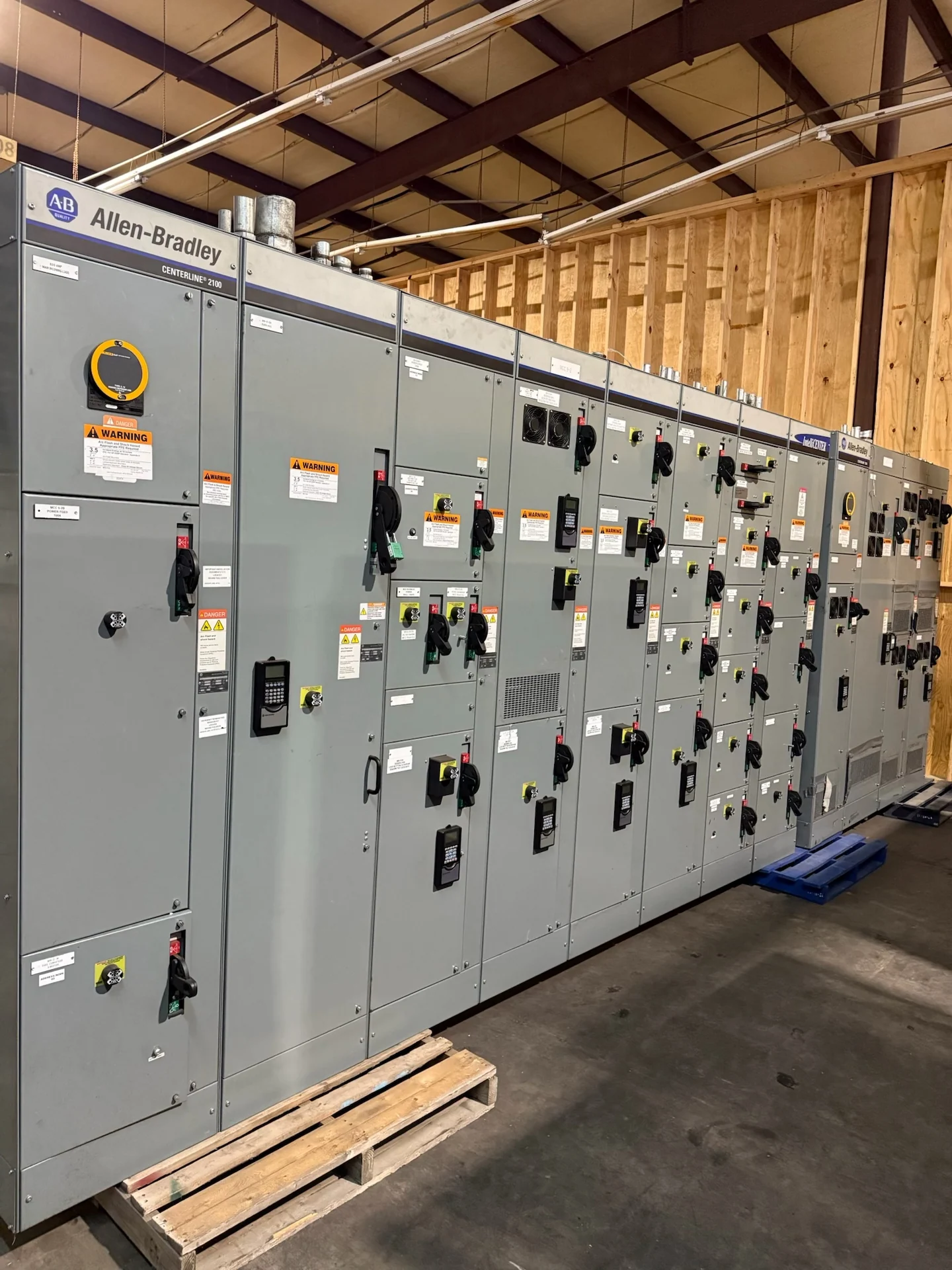
What Feeder Busway Does in a Distribution System
Feeder busway is a manufactured power-distribution assembly that carries substantial current between a source of supply and downstream equipment or a defined distribution point. Instead of routing multiple parallel conductors through a long conduit path, a busway run places enclosed bus conductors, joints, supports, and connection points into a coordinated system. The correct choice depends on the one-line diagram, continuous load calculation, voltage and phase arrangement, available fault current, installation environment, and the physical route. Switchgear Builders manufactures new electrical distribution equipment in the United States, custom to project requirements, with American components and nationwide shipping. A project review should establish exactly where the busway begins and ends before dimensions or connections are finalized.
Start with Current, Voltage, and Fault-Duty Inputs
Current rating is only one part of feeder busway selection. The design team should provide nominal system voltage, frequency, phase and wire configuration, grounding approach, calculated continuous load, expected load growth, and the protective device serving the run. Available fault current and the required withstand or short-circuit rating must also be evaluated at the relevant connection points. Those inputs influence bus conductor sizing, joint design, bracing, enclosure details, and upstream protection. A higher current rating may create additional physical or connection demands, while an underspecified rating can make the assembly unsuitable for the system. The manufacturer should review the engineer's calculations and project requirements rather than infer ratings from a product label alone.
Coordinate the Route Before Fabrication
Feeder busway is practical only when its route and interfaces are coordinated with the building or plant. Provide a dimensioned plan, elevations where the route changes, equipment locations, floor and wall penetrations, support zones, expansion or movement considerations, and the planned installation sequence. Identify whether the run is indoors or outdoors, and document moisture, dust, corrosive exposure, ambient temperature, accessibility, and enclosure requirements. The connection at each end needs its own review: a switchboard, switchgear section, transformer, generator interface, or other equipment may impose different termination dimensions and access needs. Early coordination reduces field cutting, preserves working clearances, and gives the manufacturer a reliable basis for shop drawings and shipping sections.
Connections, Joints, and Protection Need a Unified Plan
Every feeder busway project should define how sections join and how the run connects to protective equipment. Joint locations affect installation access, torque procedures, inspection points, and the division of shipping sections. Termination details should identify conductor arrangement, connection hardware, phase identification, bonding, and the interface dimensions supplied by the mating equipment. The electrical engineer and installer should also coordinate upstream and downstream overcurrent protection, selective coordination objectives where applicable, grounding and bonding, and any required metering or monitoring. A connection that fits mechanically may still require electrical review, so drawings should show both physical dimensions and circuit intent. Final details remain subject to the project design, applicable codes, and qualified installation practices.
Specify Documentation and Manufacturing Review
A useful feeder busway inquiry includes the one-line diagram, load schedule, system ratings, fault-duty information, route drawings, connection elevations, environmental conditions, support assumptions, shipping access, and the desired documentation package. Ask the manufacturer to identify assumptions, required owner-furnished dimensions, drawing submittals, inspection points, and project-specific testing or records. Shop drawings should be checked for overall length, section breaks, joint orientation, termination locations, lifting provisions, labeling, and compatibility with adjacent equipment before fabrication. Switchgear Builders can build new custom electrical equipment around the supplied project scope; the final configuration, component selection, documentation, and any requested standard applicability should be confirmed for the individual order.
Plan Shipping and Installation as Part of the Design
A long feeder busway route is normally divided into manageable sections, so logistics belong in the specification rather than being left until delivery. Confirm section dimensions and estimated weights, lifting points, packaging protection, receiving access, indoor storage conditions, and the path from the unloading area to the installation location. The project team should assign responsibilities for unloading, rigging, support installation, joint assembly, termination work, inspection, and energization checks. Nationwide shipping can be coordinated from the manufacturer's side, but destination details, freight terms, access limitations, and project timing must be agreed for the specific shipment. A clear receiving checklist helps verify section labels, hardware, drawings, and visible condition before installation begins.