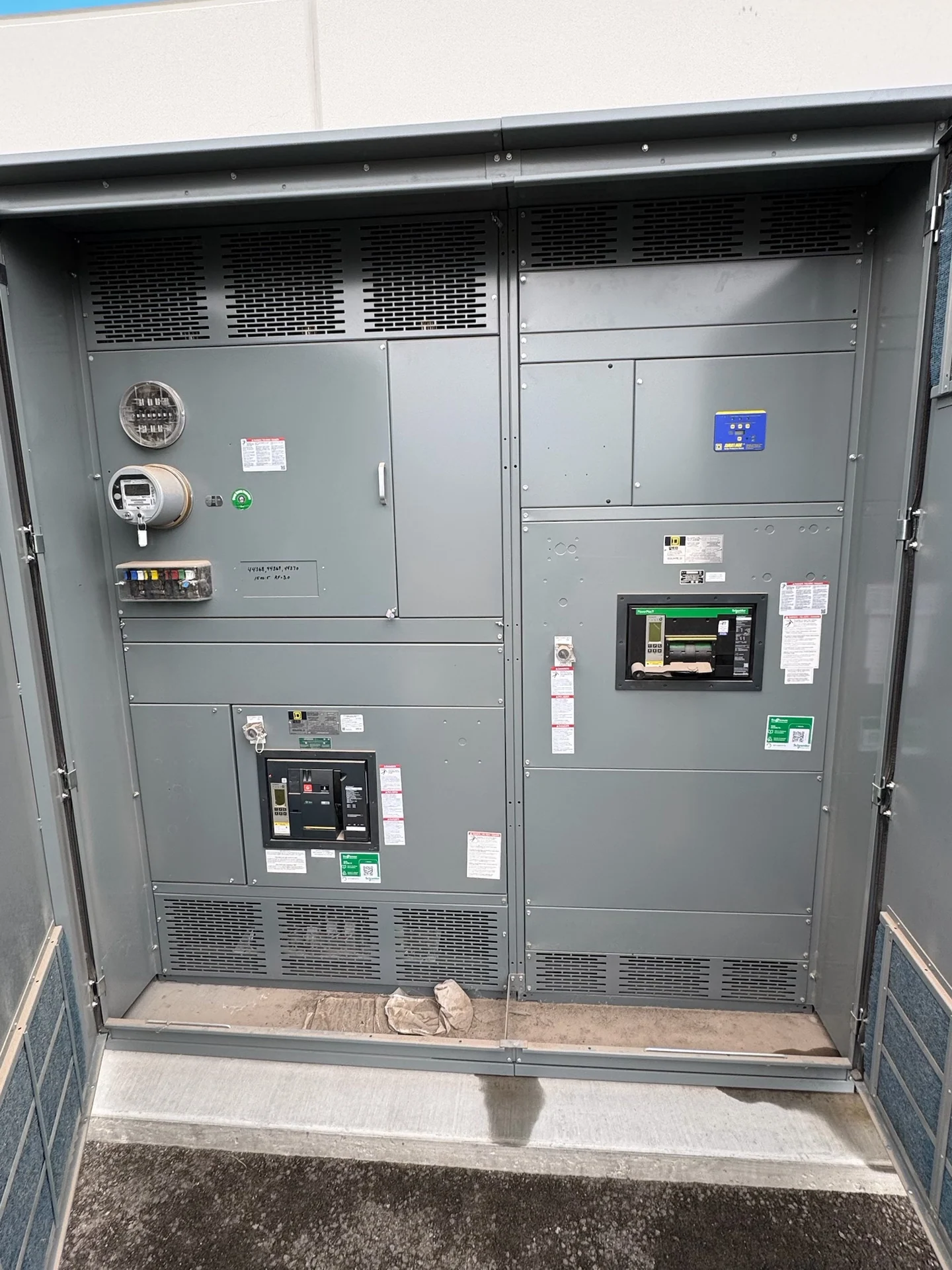
Start With a Condition Assessment
The question of when should switchgear be replaced should begin with a documented condition assessment, not an arbitrary equipment age. A qualified electrical professional can review enclosure damage, corrosion, contamination, loose or overheated connections, signs of moisture, breaker operation, insulation condition, and evidence of abnormal heating. Maintenance records, incident history, inspection photographs, and test results help separate a correctable issue from a pattern of deterioration. If the equipment presents an immediate hazard, follow the facility's safety procedures and have the system evaluated before planning further operation. A replacement inquiry should identify the lineup sections affected, the electrical function of each section, and the constraints that a new manufacturer-built assembly must satisfy.
Capacity and Fault Duty Can Change
A distribution lineup may no longer fit the electrical system after a facility adds loads, transformers, generators, renewable sources, or process equipment. Recalculate continuous current, feeder demand, available fault current, voltage, phase, frequency, grounding method, and protective-device interrupting requirements rather than copying an old nameplate. A replacement can be appropriate when the original arrangement cannot accommodate required capacity, fault duty, source configuration, or future expansion. Engineers should compare the one-line diagram with field conditions and confirm whether a replacement lineup, added section, or broader distribution redesign is the technically sound path. Switchgear Builders can manufacture new custom equipment to the project specification, using American components and shipping nationwide after the scope is defined.
Maintainability and Parts Access Matter
Maintainability is a practical replacement trigger when routine inspection, isolation, testing, or device removal has become difficult to plan safely and consistently. Review whether doors, barriers, shutters, cable compartments, control terminals, and lifting or handling provisions support the maintenance approach required by the facility. Replacement parts should be evaluated for technical compatibility, documentation, and dependable future support; a part that fits physically may still be wrong for the circuit duty, control voltage, protection scheme, or interlock sequence. When a lineup has fragmented documentation or obsolete interfaces, a new custom assembly may provide a clearer basis for drawings, labeling, controls, and installation coordination, subject to engineering review.
Safety Review Should Guide the Decision
Safety concerns deserve a disciplined assessment rather than a blanket promise that replacement alone resolves every risk. Review grounding and bonding, barriers, working clearances, arc-flash study inputs, protective settings, interlocks, access control, cable terminations, and the operating sequence for normal and alternate sources. An electrical engineer and qualified personnel should determine which findings require immediate corrective action, which can be addressed through design changes, and which justify a complete new lineup. If arc-resistant construction, seismic qualification, or a particular enclosure requirement is specified, treat it as a project requirement and confirm applicable evidence and scope. UL 891 applicability and any project-specific listing must likewise be confirmed for the actual assembly.
Plan the Replacement Around Interfaces
A replacement decision becomes actionable when the project team captures the physical and electrical interfaces that cannot be guessed from a product name. Gather field dimensions, cable entry directions, conductor sizes, termination space, bus connections, foundation or housekeeping-pad details, room access, working clearances, lifting routes, shutdown constraints, and the location of upstream and downstream equipment. Include the current one-line diagram, schedules, control schematics, protection study information, utility requirements, and photographs where available. This information lets a manufacturer develop a custom new switchgear package around the installation rather than forcing the project to adapt to an undefined standard arrangement.
Request a Replacement Quote With Useful Inputs
For a meaningful quote, describe why replacement is being considered, what must remain operational, and which functions the new equipment must perform. Identify nominal system voltage, continuous-current requirements, short-circuit information, main and feeder devices, metering, controls, source-transfer logic, enclosure environment, documentation, inspection or testing expectations, destination, and desired shipping arrangement. The manufacturer can then clarify open technical questions, exclusions, approval drawings, installation responsibilities, pricing, and delivery expectations during the quotation process. Customers looking to buy new switchgear should compare proposals on equivalent ratings, configuration, documentation, testing scope, shipping terms, and clearly stated assumptions.