Why Available Fault Current Matters
Available fault current is the prospective current that could flow if a short circuit occurs at a defined point in an electrical distribution system. It is not one universal number for an entire facility: the value changes as conductors, transformers, reactors, busway, and other impedances separate the source from each equipment location. A short-circuit study therefore supports equipment selection, protective-device coordination, and a defensible switchgear specification. The result should be reviewed by the responsible electrical engineer and compared with the applicable project requirements before a new lineup is ordered.
Inputs for a Short-Circuit Study
A useful study begins with a current one-line diagram and reliable source information. Typical inputs include utility fault-duty data at the service point, generator or inverter contribution where applicable, transformer kVA and impedance, conductor length and size, busway information, motor contribution assumptions, system voltage, phase configuration, grounding arrangement, and the operating conditions to be evaluated. The study also needs a clearly defined list of buses, mains, ties, feeders, and source combinations. Missing transformer impedance, outdated conductor details, or an omitted alternate source can materially change the calculated value and should be resolved rather than silently estimated.
Check the Actual Equipment Location
The fault-current value used for switchgear must correspond to the equipment location and operating configuration, not merely the utility service entrance. For example, a main switchboard, a downstream panel, and a motor-control lineup can each have different prospective current because intervening transformers and conductors add impedance. A main-tie-main arrangement may also produce different results with the tie open or closed, while parallel sources can increase duty. Identify the exact bus or terminals being evaluated, document source states, and make sure the study examines the highest credible contribution for the configuration the equipment may experience.
Relating Study Results to Equipment
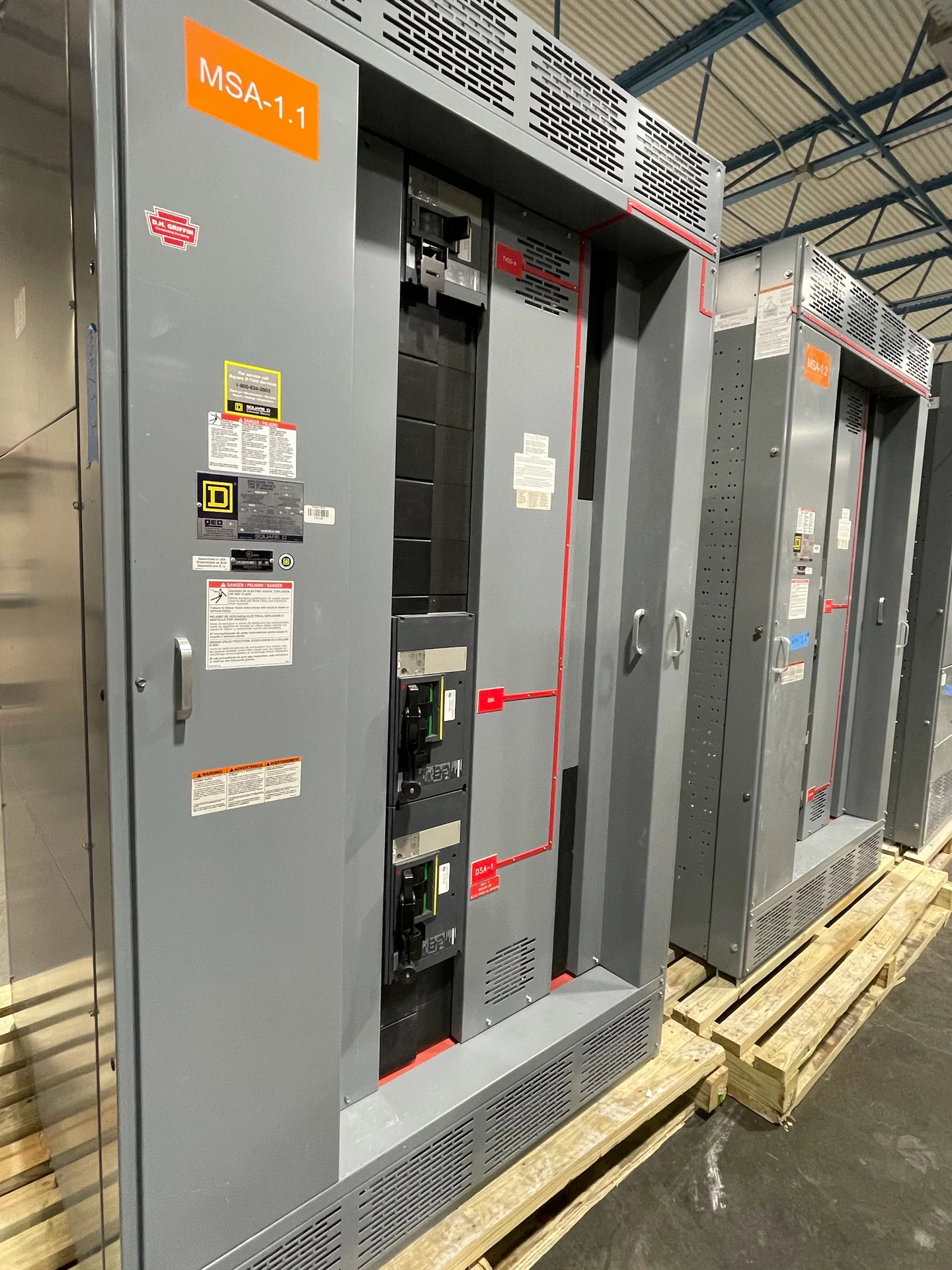
Study results help the design team specify the appropriate short-circuit characteristic for a switchgear or switchboard assembly and the interrupting capability of its protective devices. Those are related decisions, but they are not interchangeable: a circuit breaker interrupting rating, an assembly short-circuit rating, and a bus withstand requirement address different parts of the design. The engineer should reconcile calculated duty with the proposed voltage class, device arrangement, bus construction, enclosure, and source configuration. If the project may change through a transformer replacement, generator addition, or service upgrade, recalculate before final approval rather than relying on an older study.
Using the Study in a New Switchgear Quote
When requesting new custom switchgear from an American manufacturer, provide the relevant study pages or a concise schedule showing each equipment location, nominal voltage, calculated available fault current, source condition, protective-device requirements, and any assumptions. Include the one-line diagram, physical dimensions, cable-entry direction, bus arrangement, metering, controls, interlocks, and documentation expectations so the manufacturer can align the build with the engineered scope. Switchgear Builders manufactures new electrical switchgear in the United States, uses American components, and ships nationwide; project-specific ratings, construction details, and any requested standard or listing must be confirmed during engineering review.
When the Calculated Value Changes
Available fault current should be revisited whenever a source, transformer, conductor path, or operating sequence changes. Common triggers include a utility service modification, a larger transformer, added generation, a new parallel tie, relocated equipment, or a change in feeder length. A result can also change when the study model corrects an inaccurate impedance or includes a motor contribution that was previously omitted. Keep revision dates and assumptions with the equipment submittal, ask the engineer to identify the governing case, and coordinate any field changes before fabrication or installation documents are finalized.