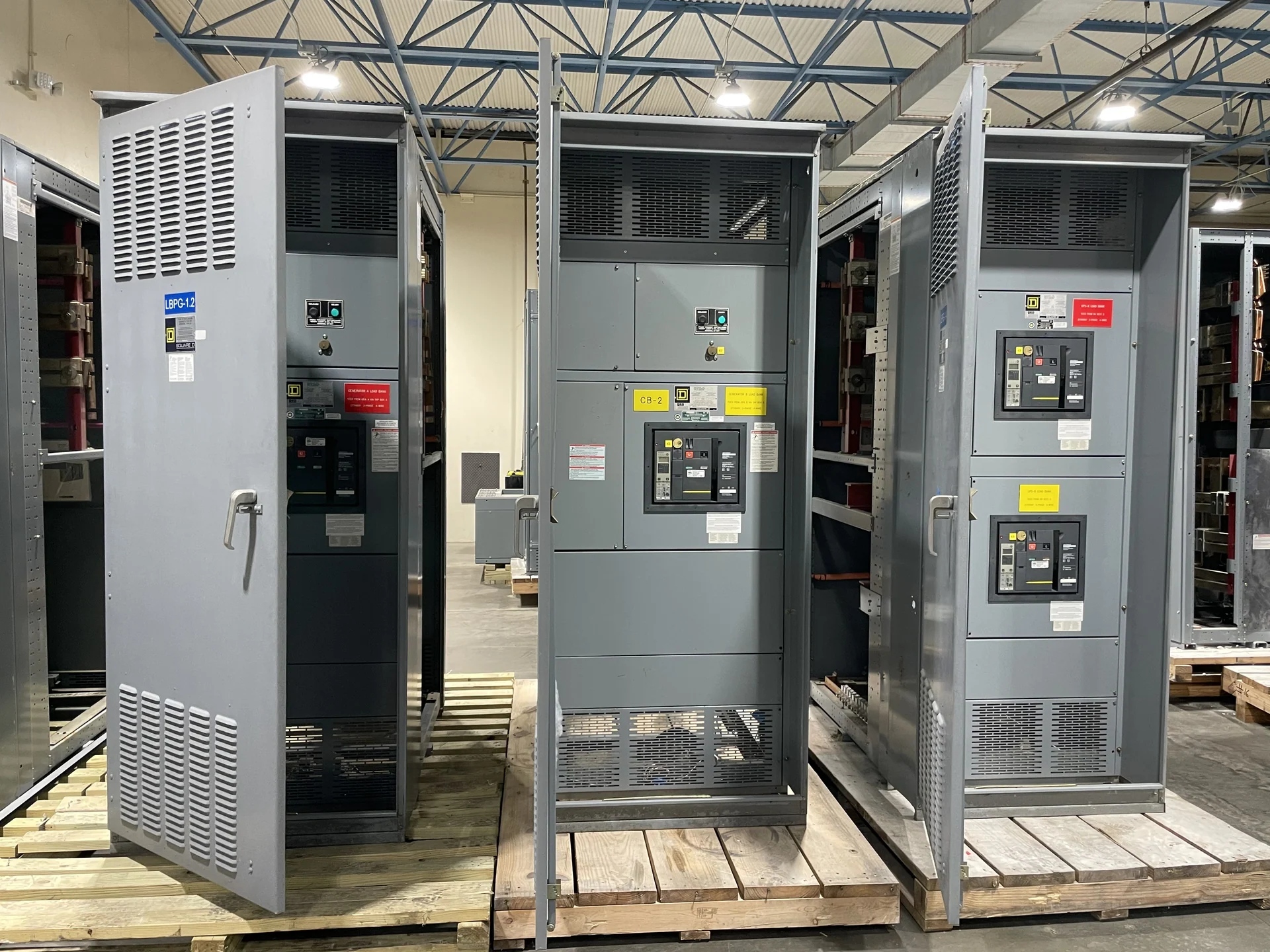
Start with the Baton Rouge Process Load
An industrial motor control center for a Baton Rouge project should begin with the process, not a generic lineup label. Identify each pump, conveyor, fan, mixer, compressor, and auxiliary motor; record its voltage, phase, full-load current, starting method, duty, and operating sequence. A load schedule should distinguish continuous, intermittent, standby, and interlocked motors, while the site one-line diagram shows sources, feeder paths, transformers, and downstream equipment. This information lets Switchgear Builders manufacture new custom equipment to a defined electrical scope rather than guessing at starter or feeder capacity. It also gives the engineer, contractor, and owner a common basis for reviewing a manufacturer quote and resolving omissions before fabrication begins.
Choose Starters, Drives, and Feeder Protection
Motor protection and starting equipment should reflect how each load actually operates. Across-the-line starters may suit some motors, while reduced-voltage starting or a variable frequency drive may better address acceleration, process control, or mechanical constraints in another application. For every motor branch, define overload requirements, short-circuit protection, disconnecting means, control voltage, bypass needs, and any coordination assumptions. Drives also introduce enclosure heat, harmonic, grounding, cable, and maintenance questions that belong in the equipment design. Final selections require qualified electrical engineering review, available fault-current information, and confirmation of the applicable project and site requirements rather than relying on a catalog default.
Coordinate the Control Interface
A useful industrial motor control center specification explains what starts a motor, what stops it, and what happens when a permissive or fault changes state. Define local and remote control stations, emergency-stop circuits, process interlocks, run and fault indication, sequence-of-operations logic, spare points, and the interface with a plant control system. Identify whether signals are hardwired, networked, or supplied through another control panel, and establish terminal numbering and wire identification conventions. Clear interface drawings prevent a lineup from being electrically complete but operationally incompatible with pumps, conveyors, or process loads. The manufacturer can then build the new assembly around documented control responsibilities and agreed review points.
Fit the Lineup to the Facility
Physical planning matters as much as the schematic. Provide the available room dimensions, lineup orientation, cable-entry direction, incoming feeder arrangement, working clearances, ventilation conditions, lifting path, and access limits at the Baton Rouge site. Consider whether doors can open fully, whether drive sections need additional service space, and how conduit or bus connections will align with the installation. Environmental information should cover indoor or outdoor placement, moisture, dust, corrosive exposure, ambient conditions, and enclosure expectations. These inputs help Switchgear Builders fabricate a custom enclosure and arrangement that the installation team can actually receive, place, terminate, and maintain, subject to project-specific engineering and site review.
Review Drawings, Testing, and Schedule Inputs
An expedited inquiry is most useful when the technical package is organized before it reaches the manufacturer. Include the one-line diagram, motor schedule, control schematics, sequence of operations, panel or lineup dimensions, specification sections, required submittals, and any owner-furnished component list. Ask for a clear distinction between design review, drawing approval, component procurement, assembly, inspection, testing, packaging, and shipment. Switchgear Builders manufactures and supplies new equipment in the United States with American components and nationwide shipping; project-specific component availability and production capacity still need confirmation. Any requested inspection or functional test should have agreed procedures, witnesses, acceptance criteria, and records.
Prepare a Complete Manufacturer Inquiry
When requesting industrial motor control centers in Baton Rouge, summarize the commercial and installation context along with the electrical details. State the destination, requested shipping arrangement, equipment quantity, preferred delivery sequence, field installation responsibilities, and the date by which technical decisions must be made, without treating a target date as a promise. Ask the manufacturer to identify assumptions, exclusions, required owner information, and unresolved interfaces in the proposal. Confirm whether the project calls for a particular standard or construction approach, and discuss whether UL 891 applies only after reviewing the exact equipment scope. A disciplined inquiry produces a more comparable new-equipment quote and reduces late changes to motors, feeders, controls, and shipping sections.